


What is Bitcoin and how does it work?
- Brita Nelson
- Feb 15, 2021
- 3 min read

Updated: Jul 4, 2021

It’s a decentralized banking system…. This means that the person who keeps track of the money isn’t one person, it’s anyone. Bitcoin’s decentralized blockchain works as a “community ledger” tracking every transaction ever made and visible at any time to anyone who wants to look. Anyone involved in tracking the transactions (called “nodes”) is a part of the verification process, comparing their ledgers to other nodes to constantly find and verify the longest chain (more on this later).
Can you see who bought and sold what? Yes and no. One of Bitcoin’s founding principles (shown below) is that it be pseudonymous. So while you can see all of the transactions made by individuals, their identity is only visible in a pseudonym or code so you can’t tell who’s who.
Bitcoin’s seven principles... show the basic guidelines for the cryptocurrency that were set out by its creator:

The guidelines set for Bitcoin create a low-trust system … And that’s on purpose. Bitcoin was created to solve the problem of trusting systems like traditional banking — where you have to trust your bank to manage your transactions and the government to manage the value of money.
No one is in charge ... and everyone is in charge. There are no centralized decision-makers when you’re all anonymous codes. This is also beneficial because it means no one can decide to inflate the coin or do something else you don’t agree with without your input.
There’s no single point of shutdown. No one can stop you from using your Bitcoin for any reason. There is no big red button and unlike the stock market, Bitcoin operates nonstop, 24/7, 365 days a year, so you don’t have to wait until after the bank holiday to use your money.
It’s seizure resistant. The government cannot seize anonymously held coins. And if you know anything about the search and seizure rules in the U.S, you’ll know how important this is.
It’s censure resistant. This one is really a pro and a con but it’s worth mentioning. Anonymity makes it possible to pay for anything — even illegal things without a record attached to your identity.
As you can imagine... since every transaction is public it’s possible to eventually figure out who’s who and doing what. But what can’t be proven is that any person is tied to a particular account. The founder of Bitcoin, Satoshi Nakamoto, is (assumed to be) a pseudonym for the creator’s real name. And his identity has been hidden since he created Bitcoin and this anonymous system in 2009.
Then why do we trust the ledger? We don’t, really. The ledger is known to be accurate because of the verification system used by the decentralized blockchain system. In order to add a new block to the blockchain, all of the ledgers (held by all of the nodes) have to be compared and one “longest ledger” has to be agreed upon by consensus before they can move forward and mine a new block.
So what’s the point of investing in Bitcoin? It’s up to you. People invest in crypto for any number of reasons. They may want to earn traditional money by playing the market, see it as the future of money and want to claim their stake or they might distrust or be unable to use traditional banks.
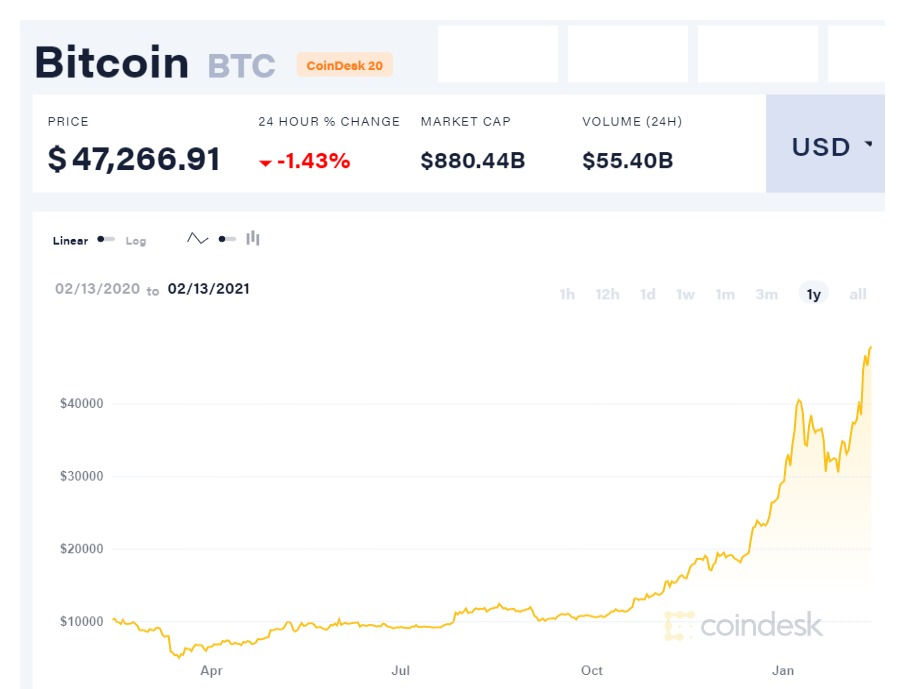
But, a lot of people are in it for the money. And it’s understandable. If you’d purchased one Bitcoin in 2016 when it cost an average of $420, it would be worth $46,445.26 as of Tuesday. That’s 110 times your initial investment. This week Bitcoin has been hitting all-time highs and inching closer to $50,000. If you’ve invested, it’s pretty exciting.
Let me know where you're at in your crypto-journey and what you'd like to learn about next. Send me a message at cryptocurrently2@gmail.com or DM me on Twitter or Instagram!


Comments